Why We Shifted from RAG to OKF: The End of "Probabilistic" Compliance
Most AI vendors will tell you their Retrieval-Augmented Generation pipeline is 'compliance-ready.' What they don't tell you is that a vector database cannot tell a deprecated statutory provision from a current one. Here's why we moved to OKF.
DataDefend Research Labs
Gurugram
September 24, 2026 ◦ 5 min read
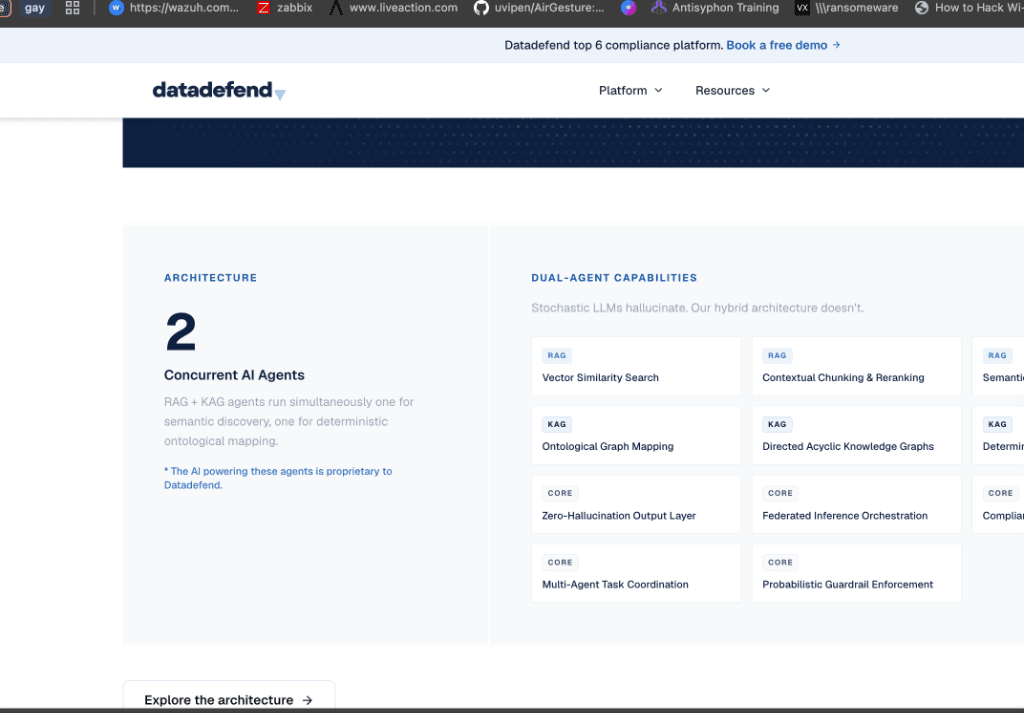
Table of Contents
The RAG Promise — and Its Hidden Liability
Most AI vendors will tell you their Retrieval-Augmented Generation (RAG) pipeline is "compliance-ready." They show you sleek dashboards where an LLM confidently answers questions about your data estate.
What they don't tell you is that a vector database cannot tell a deprecated statutory provision from a current one. It cannot guarantee that a generated citation actually exists. And under the DPDP Act, a hallucinated statutory citation isn't a "model error" — it is a critical system failure that carries the same regulatory consequence as deliberate misrepresentation.
At DataDefend, we built our early prototypes on RAG. Today, we have fundamentally shifted our core architecture to OKF (Open Knowledge Format). Here is why probabilistic retrieval has no place in enterprise compliance, and why deterministic knowledge architecture is the only path to audit-ready DPDPA compliance.
The RAG Illusion in Enterprise Compliance
RAG works by chunking documents, embedding them into high-dimensional vector space, and retrieving the "closest" matches based on cosine similarity. For summarizing a blog post, this is brilliant. For mapping DPDPA obligations, it is a liability.
In production compliance environments, RAG suffers from three fatal flaws:
- Temporal Hallucination: Vector similarity does not understand time. If a draft rule is replaced by a final notification, a RAG system may still retrieve and synthesize the deprecated text if the semantic similarity is high enough.
- Semantic Drift: Conflating GDPR Article 6 with DPDPA Section 4 because they "sound similar" in vector space — even though the legal obligations, jurisdictions, and enforcement mechanisms are entirely different.
- Unverifiable Provenance: When an LLM generates a compliance answer, tracing that answer back to the exact paragraph, version, and timestamp of the source document is often fragmented or impossible.
"You cannot satisfy Section 8(5) of the DPDP Act ('reasonable security safeguards') with a system that operates on probabilistic guesswork."
Enter OKF: The Open Knowledge Format
Instead of forcing AI to "guess" meaning from unstructured chunks, we shifted to OKF (Open Knowledge Format). Originally championed as a vendor-neutral standard for agent-ready data, OKF represents enterprise knowledge as a structured directory of Markdown files enriched with strict YAML metadata.
Instead of retrieving fragments and hoping the LLM stitches them together correctly, OKF structures the knowledge upfront so the AI agent can query it deterministically.
This is a fundamental architectural shift. RAG asks: "What document chunks look most similar to this query?" OKF asks: "What is the verified, structured answer to this query, and what is the exact provenance trail that proves it?"
Why DataDefend Chose OKF for DPDPA Compliance
The decision to move from RAG to OKF was driven by three non-negotiable requirements for enterprise compliance AI:
- Mathematically Provable Outputs: OKF allows us to map every compliance rule (e.g., 'Data Principal Rights under Section 11–14') to a deterministic node with explicit boolean logic. The AI doesn't 'generate' an answer; it traverses a verified knowledge graph and outputs a mathematically entailed conclusion.
- Zero Hallucination by Design: Because the knowledge is structured in standardized, human-readable Markdown + YAML, the system can apply strict guardrail filters. If a generated output cannot be explicitly traced to a verified OKF node, it is rejected before it ever reaches the user.
- Audit-Ready Evidence: When the Data Protection Board asks how you determined a data flow was compliant, you don't show them a vector similarity score. You show them the exact OKF YAML manifest, the traversal path, and the immutable timestamp of the rule version applied.
RAG vs OKF: A Direct Comparison
The differences between RAG and OKF become stark when evaluated against enterprise compliance requirements:
| Dimension | RAG (Retrieval-Augmented Generation) | OKF (Open Knowledge Format) |
|---|---|---|
| Knowledge Representation | Unstructured vector embeddings | Structured Markdown + YAML with strict schema |
| Retrieval Method | Cosine similarity (probabilistic) | Deterministic graph traversal |
| Temporal Awareness | None — all versions treated equally | Explicit versioning with immutable timestamps |
| Hallucination Risk | Inherent — can fabricate citations | Zero — outputs rejected if unverifiable |
| Audit Trail | Vector similarity scores (opaque) | Full YAML manifest + traversal path |
| Regulatory Acceptance | Insufficient for DPDPA Section 8(5) | Satisfies evidentiary requirements |
The OKF Ecosystem: Maturity and Adoption
OKF is not a proprietary DataDefend invention — it is an emerging open standard with a growing ecosystem of tools, validators, and integrations. DataDefend's contribution is being the first to apply OKF specifically to regulatory compliance at enterprise scale.
The ecosystem includes official tooling, generators, validators, consumers, publishers, and integrations — ranging from early-stage proof-of-concepts to production-ready GA releases. DataDefend operates in the "sweet spot" of high maturity and ease of use, making deterministic compliance intelligence accessible without requiring deep infrastructure expertise.
The Bottom Line
RAG was a necessary stepping stone for AI, but it is not the end state for regulated industries. Compliance is not about sounding plausible; it is about being provably correct.
By shifting to OKF, DataDefend ensures that Indian enterprises get deterministic, audit-ready, and hallucination-free compliance intelligence — not probabilistic guesswork dressed up in a confidence score.
"The future of compliance AI is not retrieval. It is structured, deterministic knowledge — and that future is OKF."
Ready to see the difference? Explore the architecture or book a demo to see OKF-powered compliance in action.