Consent Manager Registration Under DPDPA: Why Enterprises Running Their Own Consent Stack Don't Need It
'Consent Manager' is a defined legal term under India's DPDP Act — and it almost certainly does not describe your consent management platform. Here is why enterprises can run their own consent stack without registering with the Data Protection Board, what the law actually requires instead, and where Datadefend fits in.
Datadefend Editorial Team
Privacy & Compliance Experts
July 13, 2026 ◦ 10 min read
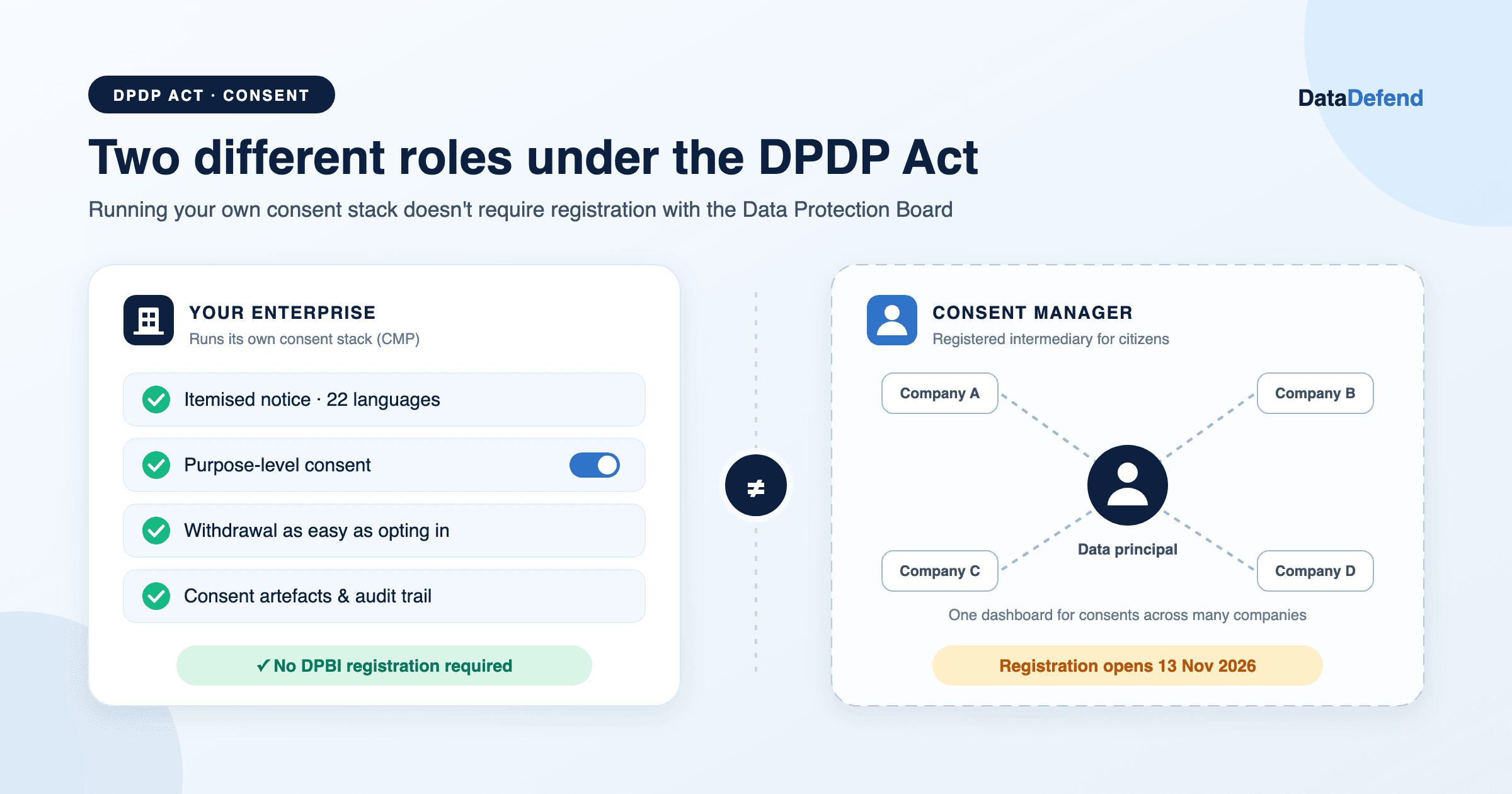
Table of Contents
The Question Every Compliance Team Is Asking
As Indian enterprises roll out consent flows under the Digital Personal Data Protection Act (DPDPA), one question keeps landing on compliance teams' desks: "If we deploy a consent management platform, do we need to register as a Consent Manager with the Data Protection Board of India?"
The short answer is no. Running your own consent stack and registering as a Consent Manager are two entirely different things under the DPDP Act — and confusing them leads businesses to either delay consent projects unnecessarily or, worse, believe a vendor who claims registration is mandatory.
This is not a loophole or a workaround. It is how the Act is deliberately designed. In this guide we unpack what 'Consent Manager' actually means in the DPDP Act, why enterprise consent management platforms fall outside that definition, what your consent stack genuinely has to deliver, and why Datadefend is built precisely for that lane.
What the DPDP Act Actually Means by 'Consent Manager'
Under Section 2(g) of the DPDP Act, a 'Consent Manager' is a person registered with the Data Protection Board who acts as a single point of contact enabling a data principal to give, manage, review, and withdraw consent through an accessible, transparent, and interoperable platform.
"A Consent Manager works for the individual, across many unrelated companies. Your consent management platform works for your business, for your own users. That single distinction settles the registration question."
Notice what this definition describes: an independent intermediary that represents the individual — not the business — and connects that individual to many unrelated data fiduciaries at once. Think of the Account Aggregator model in Indian financial services, or the DEPA framework: a neutral dashboard where a citizen can see and control every consent they have granted across dozens of organisations.
An enterprise consent management platform (CMP) is the opposite arrangement. It is engaged by the data fiduciary — your business — to collect, record, and honour consent from your own users, for your own processing purposes. Under Section 6(8) of the Act, a Consent Manager is accountable to the data principal and acts on their behalf. A CMP is accountable to you, and acts on yours. It is infrastructure, not an intermediary.
Why Your Internal Consent Stack Doesn't Need Registration
Three features of the DPDP Act and the DPDP Rules, 2025 put enterprise consent stacks clearly outside the registration requirement:
- The definition simply doesn't cover you. A CMP managing cookie consent, purpose-based preferences, and withdrawal requests for a single business (and its group entities) is acting on behalf of the data fiduciary — not brokering consent for individuals across multiple unrelated fiduciaries. Registration only becomes a live question if a platform starts operating as an independent, cross-fiduciary consent intermediary for citizens.
- Direct consent is fully permitted. Nothing in the Act or the Rules requires a data fiduciary to route consent through a registered Consent Manager. Section 6(7) makes the Consent Manager an option available to the data principal — not an obligation imposed on the business. You may obtain and manage consent directly, provided you meet the Act's notice, consent, withdrawal, and record-keeping standards on your own.
- Registration gates being a Consent Manager, not using consent tooling. The registration regime exists for entities that want to offer that interoperable, citizen-facing dashboard service. Deploying software to run your own compliant consent flows does not put you anywhere near that regime.
There is also a decisive practical point on timing: the Consent Manager registration provisions of the DPDP Rules come into force on 13 November 2026, and as of today there is not a single registered Consent Manager in India. Every enterprise consent flow in production right now is, by definition, a direct one.
That has a corollary worth remembering when you evaluate vendors: if any platform tells you today that it is a 'DPDP-registered Consent Manager', that claim cannot be true — nobody is registered yet. What you should be asking vendors is a different question entirely: can your platform meet the Act's consent standards for my users?
What Consent Manager Registration Actually Involves (And Who It's For)
Registration is a serious undertaking, designed for a small class of specialist intermediaries — not for ordinary businesses. Under the DPDP Rules, an entity seeking registration as a Consent Manager must meet conditions including:
- Incorporation in India as a company
- A minimum net worth of ₹2 crore
- A governance framework with conflict-of-interest policies covering directors, key managerial personnel, and senior management
- Secure, interoperable technical infrastructure with strong encryption and audit-ready logging
- A prohibition on dual roles — a Consent Manager cannot simultaneously act as a data fiduciary or data processor for the same data principal whose consent it manages
That last condition is worth pausing on. The dual-role prohibition means a registered Consent Manager must be structurally neutral — it cannot also be the business processing the data. This is the clearest signal in the Rules that the Consent Manager role was never meant for enterprises managing their own users' consent. The two roles are legally incompatible by design.
For virtually every enterprise, there is simply no reason to take this on. Your compliance obligations live elsewhere in the Act — and they are very achievable with the right internal stack.
What Your Consent Stack Does Have to Do
Skipping registration does not mean skipping obligations. The real compliance bar for a data fiduciary sits in Sections 5 and 6 of the DPDP Act, and it is the bar your consent stack — whoever builds it — must clear:
- Notice (Section 5): a clear, itemised notice describing the personal data collected, the purpose of processing, how to exercise rights, and how to complain to the Board — available in English and the 22 scheduled Indian languages
- Consent standards (Section 6): consent must be free, specific, informed, unconditional, and unambiguous, given by a clear affirmative action, and limited to the specified purpose
- Granularity: purpose-by-purpose consent, with no bundling of unrelated purposes into a single 'I agree'
- Withdrawal: withdrawing consent must be as easy as giving it, and processing must stop (and downstream processors be instructed) once consent is withdrawn
- Record-keeping: verifiable records of what was consented to, when, for which purpose, and under which version of your notice — ready for an audit or a Board inquiry
Here is how the two roles compare side by side:
| Registered Consent Manager | Enterprise Consent Stack (e.g. Datadefend) | |
|---|---|---|
| Acts on behalf of | Data principals (individuals) | The data fiduciary (your business) |
| DPBI registration required | Yes | No |
| Mandatory for businesses to use | No | No — but Sections 5–6 obligations still apply |
| Scope | Consent across many unrelated fiduciaries | Consent for your own users and purposes |
| Entry bar | India incorporation, ₹2 crore net worth, governance framework | Standard vendor diligence |
| Can double as fiduciary/processor | No | Yes |
| Available today | No | Yes |
In other words: the enterprise lane is not a lesser form of compliance. It is the primary compliance path contemplated by the Act — the Consent Manager is an optional, individual-facing layer that may sit alongside it later.
Where Datadefend Fits: Your Internal Consent Stack, Done Right
This is exactly the lane Datadefend's Consent Manager product was built for. Datadefend operates as your internal consent infrastructure — deployed by you, configured by you, acting on your behalf — so the registration question never arises. What it does instead is make the Sections 5–6 bar straightforward to clear:
- Purpose-level, granular consent flows with clear affirmative action — no pre-ticked boxes, no bundled purposes, no dark patterns
- Consent notices in 22 Indian regional languages, satisfying DPDPA's multilingual notice requirement out of the box
- Every consent stored as a DPDP-compliant consent artefact with timestamped audit trails and version-controlled policies — evidence-ready from day one
- A self-service privacy centre where users can review, update, or withdraw consent as easily as they gave it, with automatic deletion instructions propagated downstream on withdrawal
- A real-time Consent Check API and webhooks that sync consent state across your business systems and third-party tools
- Privacy by design: no personal identifiers stored in the consent layer itself
- Dashboard-first configuration, so legal and compliance teams can update flows, languages, and policies without engineering cycles — and go live in under a week
We built Datadefend specifically for DPDPA, rather than retrofitting a GDPR-era cookie tool for India. That focus — Indian languages, consent artefacts shaped for the Board's expectations, withdrawal propagation, and audit-first record-keeping — is why we believe it is the strongest consent management platform an Indian enterprise can put in production today.
Planning Ahead: Consent Managers and Enterprise CMPs Will Co-Exist
When registered Consent Managers do eventually arrive — the registration window opens on 13 November 2026 — they will not replace enterprise consent stacks. The two systems are expected to co-exist: businesses keep their internal CMPs for compliance workflows, while data principals may separately route consent actions through a registered Consent Manager of their choosing.
That co-existence has an engineering implication worth acting on now: the two systems will need to talk to each other. If a user withdraws consent through a future Consent Manager dashboard, that signal has to reach your systems and stop processing just as reliably as a withdrawal made on your own privacy centre.
This is why Datadefend's architecture is webhook-native today. Consent state changes — including withdrawals — already propagate to your downstream systems via webhooks and the Consent Check API. When registered Consent Managers come online and publish their interoperability APIs, plugging that external withdrawal signal into your existing Datadefend workflows is an integration, not a re-architecture. Enterprises that build this plumbing now will treat November 2026 as a non-event.
The Bottom Line
- Running an internal consent stack does not require Consent Manager registration under the DPDP Act — the two are different things by definition
- Registration is only for entities that want to be an independent, citizen-facing consent intermediary across many fiduciaries — a role that is legally incompatible with being a data fiduciary anyway
- No Consent Manager is registered in India today; the registration window opens 13 November 2026, so every current consent flow is a direct one
- Your real obligations are Sections 5 and 6: itemised multilingual notice, free/specific/informed/unconditional/unambiguous consent, easy withdrawal, and verifiable records
- Datadefend is purpose-built for exactly that lane — and its webhook-native design keeps you ready for Consent Manager interoperability later
If you are scoping your DPDPA consent programme and want to see what a compliant internal consent stack looks like in practice, talk to our team or explore the Datadefend Consent Manager.
This article is for general information only and does not constitute legal advice. For guidance on your specific obligations under the DPDP Act and Rules, consult a qualified legal professional.