Data Security Posture Management (DSPM) for DPDPA: What Indian Enterprises Actually Need
You can't secure data you don't know you have. Here's what DSPM means under Indian law specifically — how it maps to DPDPA Section 8(5) safeguards, where shadow data creates real penalty exposure, and how to tell a genuine DSPM capability from a rebadged data-discovery tool.
Datadefend Editorial Team
Privacy & Compliance Experts
August 7, 2026 ◦ 10 min read
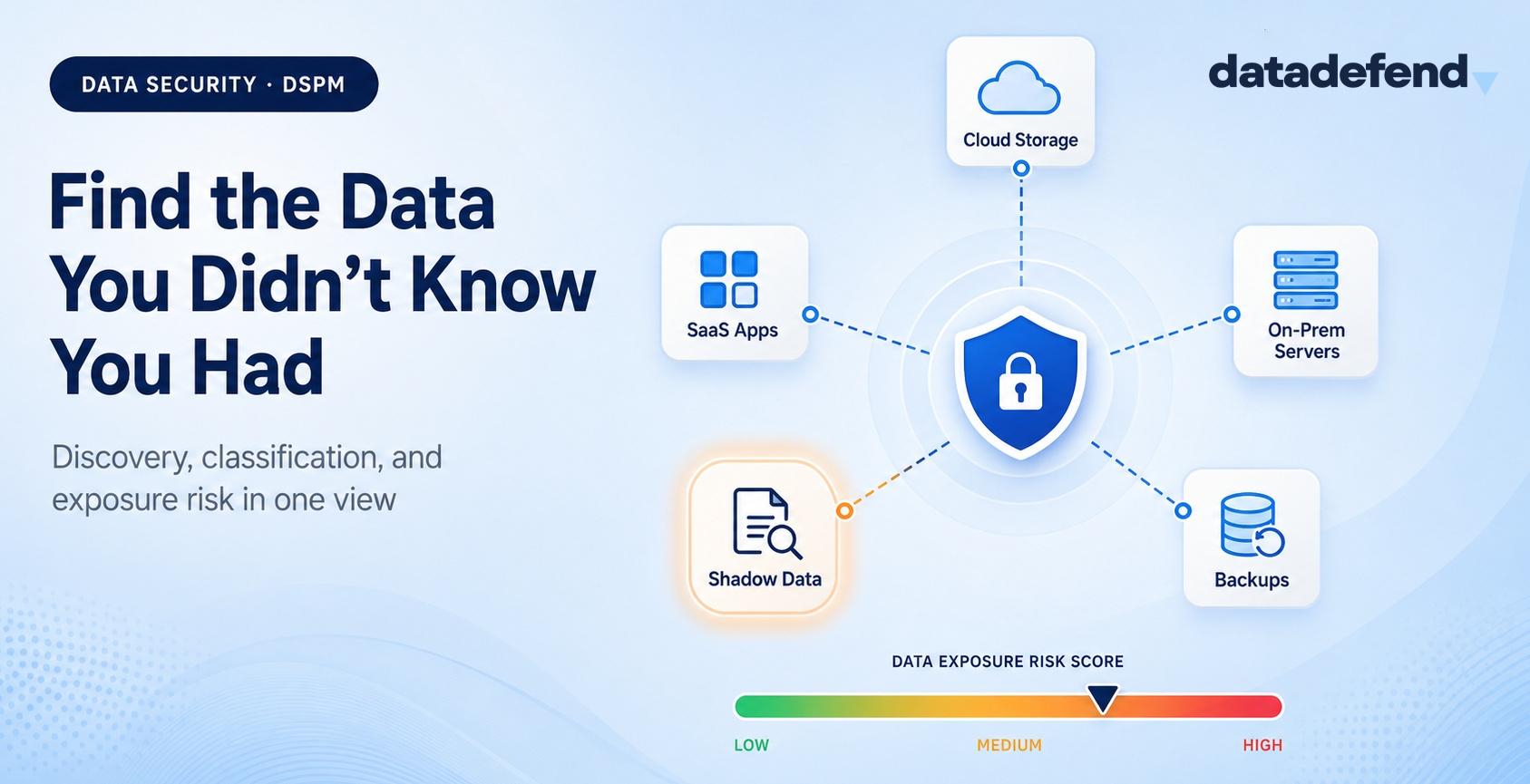
Table of Contents
The Compliance Gap Nobody's Data Map Shows
Most Indian enterprises can describe their data protection program in a slide: consent banners on the website, a DSAR portal, a vendor questionnaire process, maybe a DPIA template. What that slide almost never shows is the backup snapshot sitting in an S3 bucket with public read access, the analytics export sitting in a shared drive since 2023, or the staging database seeded with real customer records because someone needed test data in a hurry.
That's the gap Data Security Posture Management (DSPM) exists to close. It isn't a consent tool, and it isn't a firewall. It's the discipline of continuously finding where sensitive data actually lives — across cloud, SaaS, and on-premises systems — classifying what it is, checking who can reach it, and flagging exposure before a regulator or an attacker finds it first.
Under the DPDP Act, this isn't optional hygiene. Section 8(5) requires data fiduciaries to implement 'reasonable security safeguards' to prevent personal data breaches, and Rule 6 gets specific about encryption, access control, and monitoring. None of that is achievable against data you don't know you have. This guide breaks down what DSPM actually means for Indian enterprises, why it's become urgent as DPDPA enforcement approaches, and what separates a real DSPM capability from a repackaged data-discovery feature.
- DSPM finds sensitive data across every environment — not just the systems you already know about
- It classifies data by type and sensitivity, and maps that directly to regulatory exposure
- It evaluates access and exposure risk, not just whether data exists
- It feeds continuous monitoring and automated remediation, not a one-time audit report
- Under DPDPA, it's the visibility layer that makes Section 8(5) safeguards enforceable in practice
Why DSPM Matters for DPDPA Compliance Right Now
Two things have converged to make this urgent. First, Indian enterprises have spread personal data across more systems than ever — multi-cloud deployments, dozens of SaaS tools per department, and analytics pipelines that copy data faster than anyone can track it. Second, DPDPA enforcement is no longer theoretical: the Data Protection Board is operational, and core safeguard obligations under Section 8(5) apply from May 13, 2027.
The compliance programs most exposed right now are the ones that built consent and notice workflows first — which is the right sequence for the front door — but never went back to audit what happens to that data after it's collected. A patient's consent record is compliant at the point of capture and then becomes a liability the moment a copy of it sits in an unmonitored data lake with no access review since it was created.
"A DSPM program's job isn't to make your data estate look secure on a dashboard. It's to make the exposure you already have visible enough to actually fix."
This is also where 'shadow data' becomes the highest-risk category in most environments — data that exists outside sanctioned, tracked systems: old backups, forgotten test environments, spreadsheet exports, or a SaaS tool a team signed up for without informing IT or security. Shadow data carries identical DPDPA exposure to data in your production systems, but almost always has weaker or nonexistent controls around it.
The Five Capabilities That Define Real DSPM
A lot of tools claim DSPM as a feature. Genuine DSPM capability means all five of the following work together, not just the first one.
| Capability | What It Actually Does | DPDPA Relevance |
|---|---|---|
| Data Discovery & Visibility | Automatically finds data across cloud, SaaS, on-prem, and shadow stores | You cannot apply Section 8(5) safeguards to data you don't know exists |
| Classification & Context | Categorises data by type (PII, financial, health) and maps it to regulatory frameworks | Determines which DPDPA obligations and penalty exposure apply to each dataset |
| Access Governance & Risk Scoring | Flags over-privileged users and public exposure, scores risk by sensitivity and exposure | Directly supports the access-control safeguards required under Rule 6 |
| Continuous Monitoring & Alerting | Tracks data movement and access behaviour in real time, flags anomalies | Feeds the evidence trail needed for breach detection and the 72-hour notification clock |
| Automated Remediation | Revokes access, encrypts, masks, or deletes exposed data through policy workflows | Converts a finding into an actual reduction in breach exposure, not just a report |
Miss any one of these and the tool becomes a point-in-time inventory rather than a posture management system. A discovery scan you run once a quarter tells you what was true a quarter ago — DSPM is only useful when it's continuous.
Making DSPM Work Across Teams, Not Just Security
DSPM findings are only valuable if the right team can act on them quickly. A finding that sits in a security dashboard nobody outside the security team checks doesn't reduce exposure — it just documents it.
- Route findings to data owners, not just security — the person who created the shadow dataset is usually the fastest path to remediation
- Integrate with existing ticketing tools (ServiceNow, Jira) so remediation becomes a tracked task, not an email that gets lost
- Give IT operations and cloud teams visibility into exposure tied to the infrastructure they manage
- Test policy changes in a sandbox before enforcing them in production — an overly aggressive access-revocation policy can break a legitimate workflow as easily as it closes a risk
This cross-team handoff is where most DSPM rollouts stall. The tooling finds the exposure; the organisational workflow around it decides whether that exposure actually gets closed within a reasonable time.
Turning DSPM Findings Into Audit-Ready Evidence
A regulator or auditor won't ask whether you have a DSPM tool. They'll ask whether you can show, for a specific dataset, what it contains, who could access it, whether that access was appropriate, and what happened when a risk was identified.
- Map every finding to the specific regulatory framework it affects — DPDPA, and where relevant, GDPR or HIPAA for cross-border data
- Keep immutable logs of when exposure was discovered, who was notified, and when it was remediated
- Generate business-readable violation views, not just technical scan output — a DPO needs to see risk in terms of obligations, not just CVE-style findings
- Export evidence in a format ready for a Data Protection Board inquiry without a week of manual reconstruction
This is the difference between a security team that can say 'we have a DSPM tool' and one that can say 'here is exactly how we found, scoped, and closed this exposure, with a timestamp at every step.' Only the second version survives an actual audit.
Who Should Actually Own DSPM Inside an Enterprise
| Role | What They Need From DSPM |
|---|---|
| CISO / Security Leadership | Real-time posture view and board-ready risk reporting |
| DPO / Privacy Team | Compliance oversight mapped to DPDPA obligations, with audit-ready evidence on demand |
| Data & Cloud Teams | Concrete access-management actions and data-zone control, not just alerts |
| Application Owners | Security guardrails that don't block legitimate delivery timelines |
In practice, DSPM works best as a shared responsibility with the DPO as the accountable owner for compliance framing and security as the operational owner for remediation — not as a tool bought by one team and ignored by the rest.
Where Datadefend's DSPM Module Fits

Datadefend's DSPM module is built as part of the same platform that handles consent, DSAR, vendor risk, and breach management — not as a bolted-on discovery scanner. That matters because a DSPM finding is most useful when it connects directly to the rest of your compliance evidence, not when it lives in a separate tool your DPO has to cross-reference manually.
- Continuous discovery of misconfigured data stores, overexposed datasets, and shadow data across cloud and on-premises environments
- Every finding ranked by data sensitivity using Datadefend's AI classifier — so remediation gets prioritised by actual regulatory exposure, not just technical severity
- Findings feed directly into Datadefend's breach management workflow, with scope pulled automatically from the live data map
- Access-risk findings connect to the same vendor and processor register used for DPDPA vendor risk management
- Audit exports map findings to DPDPA sections and rules automatically, ready for Data Protection Board review
"The point of DSPM isn't a cleaner dashboard. It's being able to answer, for any dataset a regulator asks about, exactly where it is, who could reach it, and what you did about it."
Start by Finding What You Don't Know You Have
Before evaluating any DSPM tool, run one exercise internally: ask three teams — security, data engineering, and a business unit — to independently list every place they believe customer data lives. The gaps between those three lists are usually where your real exposure sits.
DPDPA doesn't require perfect data hygiene. It requires reasonable safeguards, applied to data you can actually account for. DSPM is what makes that accounting possible at the scale modern enterprises operate at — and it's the foundation the rest of a DPDPA program stands on, whether or not it gets a line item on the compliance slide.
Datadefend offers a free account with 3,000 consent collections per month, no credit card required — and DSPM discovery is part of the same platform, not a separate purchase.